
𝗝𝗢𝗜𝗡 𝗢𝗨𝗥 𝗪𝗛𝗔𝗧𝗦𝗔𝗣𝗣 𝗖𝗛𝗔𝗡𝗡𝗘𝗟! 𝗖𝗟𝗜𝗖𝗞 𝗢𝗡 𝗧𝗛𝗘 𝗟𝗜𝗡𝗞: https://whatsapp.com/channel/0029VaN7nmQGOj9na4QhBa12

The Government of Antigua and Barbuda has recommenced work on the development of its Universal Health Coverage (UHC) framework, with National Health Insurance (NHI) identified as a principal mechanism for ensuring that residents can access essential healthcare services without facing financial hardship.
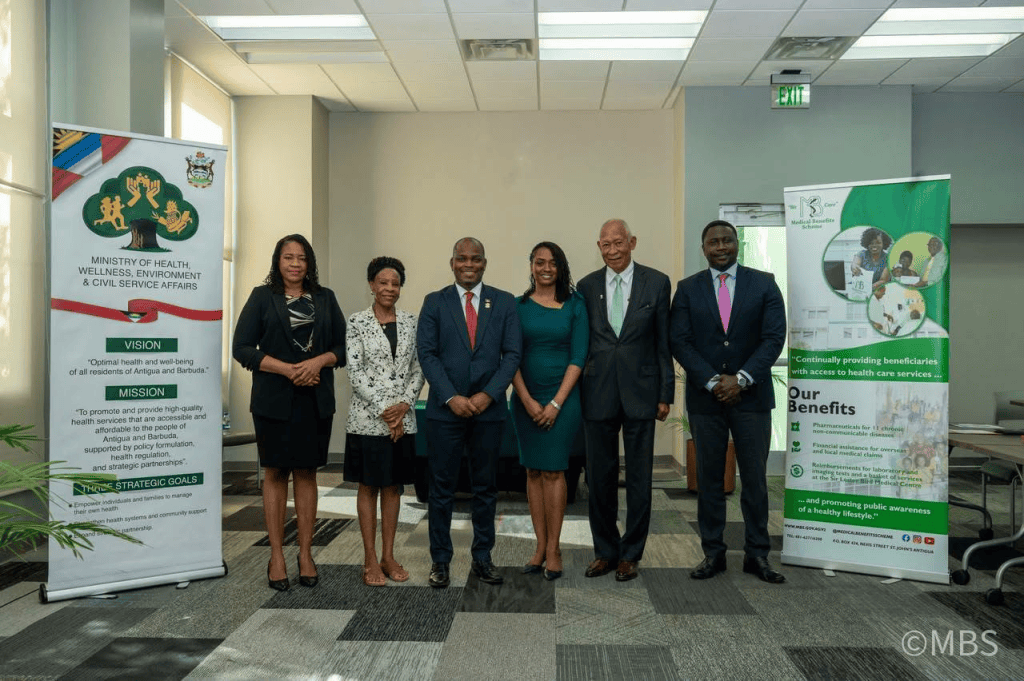
The Ministry of Health, Wellness, Environment and Civil Service Affairs convened a working meeting of the Steering Committee on Monday, 12 October 2026, at the John E. St. Luce Finance & Conference Centre.

The meeting marked the relaunch of the programme and focused on confirming the Steering Committee’s membership and mandate, establishing the technical subcommittees, and advancing the preparatory work required to guide the programme’s development and implementation.
In attendance were the Honourable Michael Joseph, Minister of Health, Wellness, Environment and Civil Service Affairs; His Excellency Sir Lionel Hurst, Chairman of the Medical Benefits Board; Mr Kevin Silston, Chief Executive Officer of the Medical Benefits Scheme; and Ms Hildred Simpson, Permanent Secretary in the Ministry of Health, Wellness, Environment and Civil Service Affairs as well as other Senior Technical Officers within the Ministry and the MBS.

Addressing the meeting, Minister Joseph underscored the Government’s commitment to making quality healthcare more accessible, equitable and financially sustainable for the people of Antigua and Barbuda.
“At its heart, Universal Health Coverage is about people. It means ensuring that every Antiguan and Barbudan can obtain appropriate, quality healthcare without facing financial hardship. That principle must guide our work,” the Minister stated.

Minister Joseph emphasised that Universal Health Coverage extends beyond the financing of healthcare and requires a broader transformation in how services are organised, funded and delivered.
He noted that while the Government has expanded healthcare services, strengthened institutions and invested in medical professionals, gaps remain in access to services, financial protection and the system’s ability to respond to the changing needs of the population.
He also clarified the distinction between Universal Health Coverage and National Health Insurance, noting that UHC is the overarching objective, while NHI is one of the principal mechanisms through which the Government intends to achieve it.

The proposed transition of the Medical Benefits Scheme towards a National Health Insurance Programme is intended to strengthen access to essential healthcare, reduce out-of-pocket medical expenses and improve financial protection for households, particularly vulnerable groups.
The Minister stressed that the programme must be designed to meet the country’s needs while remaining financially responsible, administratively workable and sustainable over the long term.

He acknowledged the technical work already undertaken by the Health Economics Unit of The University of the West Indies, describing it as a foundation upon which the current process can build.
The committee’s task will include reviewing the existing work against current national circumstances, identifying gaps and developing practical recommendations.

The Steering Committee will direct and coordinate the overall process, while the technical subcommittees will examine key areas, including healthcare financing, the benefits package, governance, legislation and service delivery. Their work will inform recommendations on the structure and operation of the proposed programme.
Minister Joseph further emphasised the importance of stakeholder participation, noting that the programme’s development must draw on the expertise of healthcare professionals, institutional managers and technical specialists, while also taking account of the views of patients, communities, employers and workers.
Three central questions will guide the process: what essential services should everyone be able to access; how those services can be financed fairly and sustainably; and how vulnerable persons can be protected while ensuring quality and accountability.

The Government is targeting completion of the programme’s design and preparatory work by the end of 2027, with implementation expected to begin in January 2028. The Steering Committee will consolidate the recommendations into a national framework for the Government’s consideration, while the Ministry will support the policy decisions, approvals and preparations required for implementation.

Minister Joseph acknowledged that limited resources will require careful consideration of competing priorities, stressing the need for evidence-based recommendations and a system that can be sustained over time.
The relaunch of the programme represents a further step in the Government’s efforts to advance Universal Health Coverage in Antigua and Barbuda, with the proposed National Health Insurance Programme intended to strengthen financial protection, improve access to essential services and support a more equitable and sustainable healthcare system.




Leave a Reply