
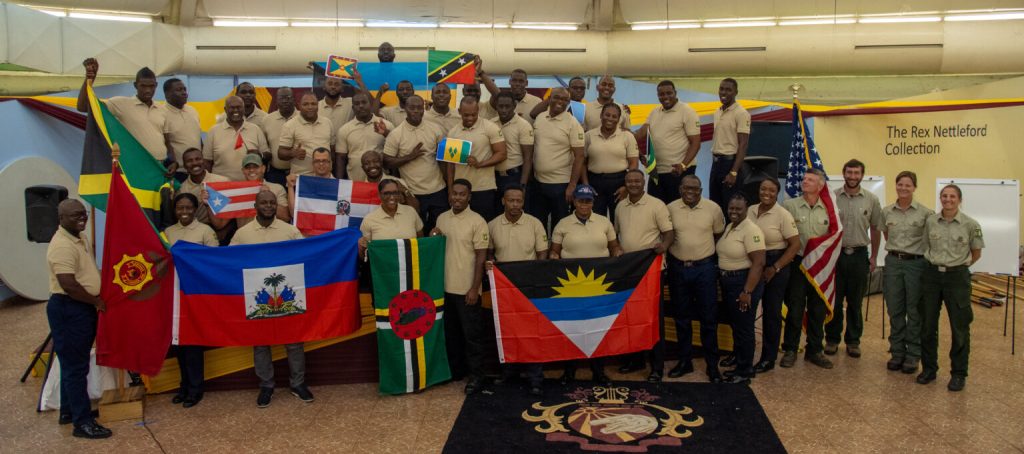
Our Today – The United States Forest Service (USFS), through its Natural Infrastructure for Caribbean Resilience (NICaR) programme, concluded a week-long training series to strengthen regional capacity for wildland (bush) fire management with 35 firefighters from 14 Caribbean countries.

With funding from the Department of State, a comprehensive series of wildland fire training courses were delivered through the programme’s NICaR Wildland Fire Management Academy at the University of the West Indies (UWI) Mona campus from June 19-24.
The NICaR Wildland Fire Academy, the first of its kind in the region, has been implemented in response to the need for greater collaboration around fire prevention and management especially for wildland fires.

This is particularly important in the context of climate change which results in more frequent and intense fire weather conditions and increased risk for wildfires. The acquired knowledge and skills will contribute to the region’s overall resilience against the increasing challenges posed by wildfires.
The academy featured interactive workshops, practical field exercises, and simulations covering topics such as wildland environment components, human performance concepts, fireline construction and tools as well as communication methods.

The 14 participating countries included Antigua & Barbuda, Barbados, Dominica, Dominican Republic, Grenada, Haiti, Jamaica, Puerto Rico, St. Kitts & Nevis, St. Lucia, St. Vincent & the Grenadines, Trinidad & Tobago and The Bahamas.
Julian Davis Buckle, deputy commissioner of the Jamaica Fire Brigade, said the programme has fostered a spirit of unity and cooperation within the region.
“By joining forces and sharing knowledge, expertise and resources, we will be able to create a robust network of support empowering each other to address fire-related issues. We will create a repository of knowledge that can be used to mitigate the risk associated with wildland fires.

This will aid each of us in the development of comprehensive strategies that will be concerned with the unique ecological and environmental factors within each of our regions,” mused Buckle.




 safety steps
Leave a comment